You’re behind a school bus when its red lights begin flashing and the stop arm swings out. That familiar morning pause is now part of a new enforcement program in Palm Beach County, where school bus stop arm cameras will help identify drivers who pass a stopped bus.
By Janice Robinson-Celeste
Audio: Audio version coming soon.
Quick Review
- About 750 Palm Beach County school buses are equipped with stop-arm cameras.
- Mailed educational warnings begin November 16, 2026; enforcement and a $225 civil penalty begin January 5, 2027.
- Deputies review each camera flag before a notice is sent. The penalty does not add license points.
- Florida drivers generally must stop for a bus displaying flashing red lights or an extended stop arm.
- Teach children that a driver may fail to stop, even when a bus’s stop arm is out.
How School Bus Stop Arm Cameras Work In Palm Beach County
The School District of Palm Beach County and Palm Beach County Sheriff’s Office have launched the Palm Beach County School Bus Passing Safety Program with BusPatrol. According to CBS12 News reporting by Kaitlyn Kowalski, about 750 district buses have cameras that activate when the bus displays flashing red lights. The cameras capture photos and video of vehicles that appear to pass.
A camera flag does not automatically mean a ticket. Sheriff’s deputies review each flagged incident, and if a deputy confirms a violation, a notice is mailed to the vehicle’s registered owner.
Starting November 16, 2026, drivers recorded passing a stopped bus will receive an educational warning by mail, without a financial penalty during the warning period. Full enforcement begins January 5, 2027. Confirmed violations carry a $225 civil penalty, with no points added to the driver’s license.
If you receive a notice, follow its instructions to review the evidence. The program says evidence can be viewed at AlertBus.com. The notice includes instructions for contesting it or transferring liability to another driver.
When You Must Stop For A School Bus In Florida
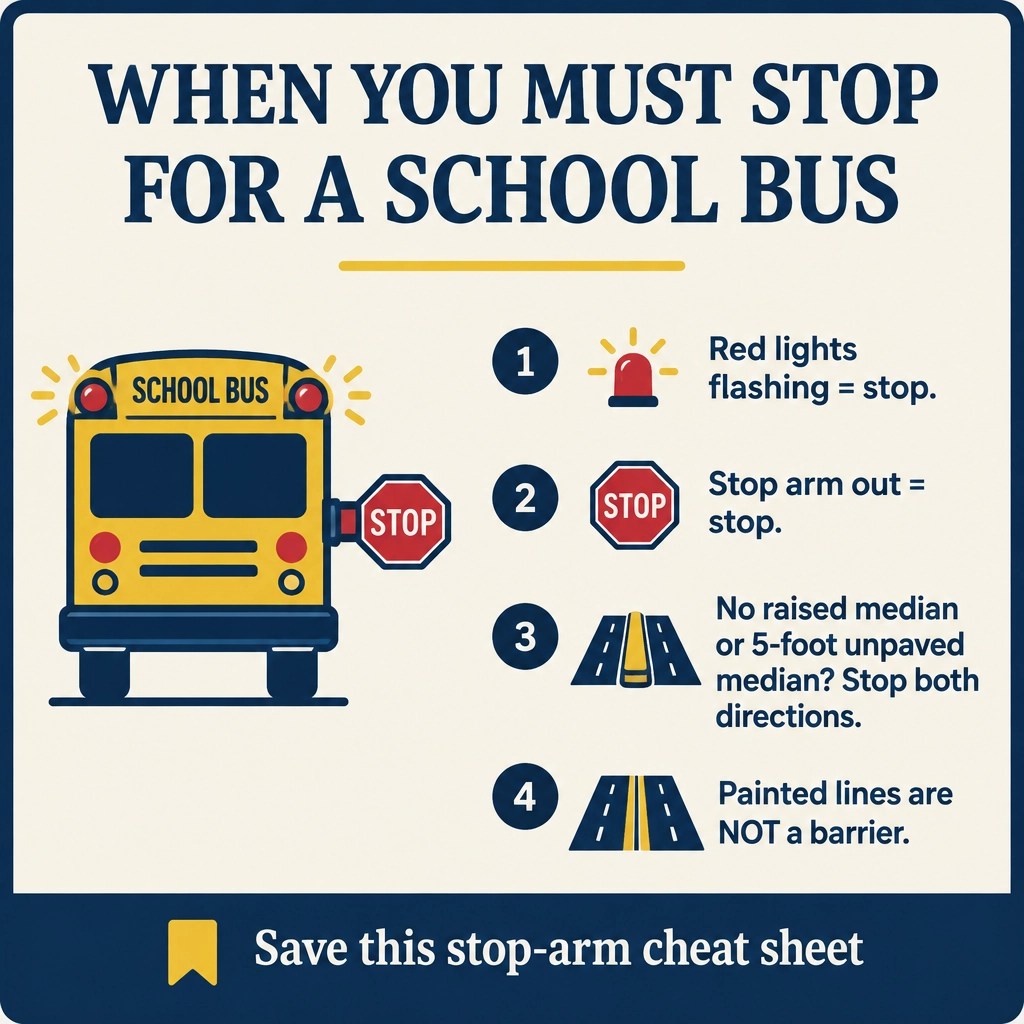
For drivers asking, “Do I have to stop for a school bus?” the answer depends partly on the road. In Florida, drivers must stop when a school bus displays flashing red lights or extends its stop arm. Stay stopped until the signals are off and the bus begins moving.
Here is the general Florida example:
- Two-lane road: Traffic in both directions must stop.
- Multi-lane road without a physical barrier or raised median: Traffic in both directions must stop. This includes a road with a center two-way turn lane.
- Divided highway with an unpaved median at least five feet wide or a raised physical barrier: Drivers going in the opposite direction do not have to stop, but must slow down and watch for children. Drivers going in the same direction as the bus must stop.
- Painted lines: Pavement markings alone do not count as a physical barrier.
Other states may have different rules. Check your state’s law and your district’s safety guidance rather than assuming Florida’s rules apply where you live.
Why A Passing Driver Puts Children At Risk
The National Association of State Directors of Pupil Transportation Services estimates that drivers illegally pass stopped school buses about 40 million times nationwide each year. CBS12 also reports that a single-day survey in Florida recorded more than 8,000 illegal passes, and that the National Highway Traffic Safety Administration ranks Florida second in the nation for fatal school-bus-related crashes.
Those figures describe a risk children can encounter in ordinary routines, especially as they approach or leave a bus. The area close to the bus, often described as the danger zone, can be difficult for drivers to see. Children may cross in front of the bus, where a driver passing illegally may be least likely to notice them.
A recent incident in Brownsville, Texas, is a reminder that school travel safety includes the minutes children are walking near roads. KRGV reported that a vehicle hit three siblings, ages 16, 11 and 7, in a crosswalk on Southmost Boulevard as they walked to school. Police said the two younger children were seriously injured and remained in stable condition, while the teen had minor injuries. KRGV reported the driver stayed at the scene and was arrested. These details are attributed to KRGV and police; they do not establish fault beyond what was reported.
Brownsville ISD reminded motorists to slow down in school zones and remain alert for students and pedestrians during arrival and dismissal. Stop-arm enforcement is one part of a broader safety effort: attentive driving, safe walking habits, and clear school transportation routines all matter.
Drivers illegally pass stopped school buses about 40 million times a year. Every one of those passes happens where a child might be standing.
Know a parent who needs this? Send it to them.
A Parent Checklist For Walking Routes
November mornings can be dark, and a route that looks simple in daylight may feel different before sunrise. Walk the route with your child and practice where to wait, where to cross, and what to do if traffic is moving unpredictably.
- Wait for the bus to leave before crossing when there is no crossing guard and your child needs to cross near the bus. Follow the school’s or crossing guard’s instructions where present.
- Make eye contact with drivers before crossing, but teach children not to assume a driver has seen them or will stop.
- Treat driveways and the stretch between the curb and bus as places where cars may move. Pause, look both ways, and use designated crossings when available.
- Practice the route before dark or at the same time of day your child will walk it. Check visibility, crossings, and places to wait safely.
For more practical guidance on safer bus routines, read our related article, School Bus Drop-Off Safety for Kids: The Maryland Mistake Every Parent Should Learn From.
If Your Child Rides A Bus On A Risky Road
Tell your child that even when the stop arm is extended, they should never assume every nearby driver has stopped. They should stay alert, follow the driver’s directions, and use the bus’s designated crossing procedure.
If your child witnesses a vehicle passing the bus, encourage them to tell the driver or another trusted adult. If it is safe and practical for an adult to note details, record the bus number, time, location, and vehicle license plate, then report the incident to the school district or police. Do not encourage a child to approach a vehicle or step into traffic to collect information.
Stop-arm camera programs operate in many states, but arrangements vary. Ask your child’s school district whether it has a program, how incidents are reported, and what review process applies.
Frequently Asked Questions
Do stop-arm cameras exist in other states?
Yes. Programs and enforcement procedures vary by state and district. Contact your school district or local transportation office to learn what is in place in your community.
Is Palm Beach County’s $225 penalty a moving violation?
The Palm Beach program describes it as a civil penalty and says it does not add points to a driver’s license. Check the notice for the specific instructions that apply to your case.
What if I receive a notice?
Use the violation number and license plate information to view evidence at AlertBus.com. The notice provides instructions for contesting it and for transferring liability when another person was driving.
What is the fine for illegally passing a school bus in Florida without cameras?
Passing a stopped school bus in violation of Florida law is illegal. Penalties and procedures may depend on the circumstances and applicable law. This article does not assign a separate fine amount beyond the Palm Beach program’s $225 camera-program penalty.
Strengthen Your Family’s Bus Safety Plan
Talk through the rules with every adult who drives your household vehicle, and review your child’s walking or riding routine together. Palm Beach County’s new program brings camera evidence and deputy review into bus enforcement, while everyday attentiveness remains essential to a safer trip to and from school.
Join the Secure Children’s Network newsletter for practical child-safety resources and updates. Subscribe through Secure Children’s Network.
Does your child walk to the bus or ride on a road where drivers sometimes pass, and does your district have stop-arm cameras?
If this helped, share it with another parent and follow Secure Children's Network on Facebook, X and LinkedIn for safety alerts.
Discover more from
Subscribe to get the latest posts sent to your email.