By Janice Robinson-Celeste
Your toddler spots the open dresser drawers and starts climbing them like a ladder. You’ve babyproofed the outlets and cabinets, but that dresser, and any TV sitting on it, may still need one important safety check: furniture tip-over safety.
Quick Review
- Anchor dressers, bookcases, and televisions to the wall.
- Keep TVs off dressers. Put flat-screen TVs on low, stable stands.
- Check every room where a young child spends time, including bedrooms and play areas.
- Older furniture may not meet the current stability standard, so anchor it even if it looks sturdy.
Why Dressers Deserve a Safety Check
A dresser can seem heavy and stable until a child opens a drawer, climbs, or pulls on it. Open drawers can shift a unit’s weight forward. A TV on top adds more weight and can create an especially hazardous combination.
The U.S. Consumer Product Safety Commission’s 2023 tip-over report estimates that tip-overs involving televisions, furniture, and appliances sent an average of 17,800 people to emergency departments each year from 2020 through 2022. Children under 18 accounted for 44% of those victims. The report also records 217 reported tip-over deaths from January 2013 through July 2023, 155 of them involving children.
CPSC estimates that someone is treated in an emergency department for a tip-over injury about every 30 minutes. Know a parent who needs this? Send it to them.
The CPSC’s Anchor It! campaign reports that nearly 80% of tip-over fatalities involve children age five and younger. The message is practical, not complicated: secure furniture and TVs so a child’s curiosity does not turn an ordinary room into a preventable hazard.
Furniture Tip-Over Safety Starts With Anchoring
The STURDY Act became law in December 2022. A mandatory stability standard for clothing-storage units, including dressers, took effect on September 1, 2023. That is an important safeguard, but it is not a reason to skip anchoring. Dressers bought before that date may not meet the standard, and CPSC recommends securing furniture to the wall.
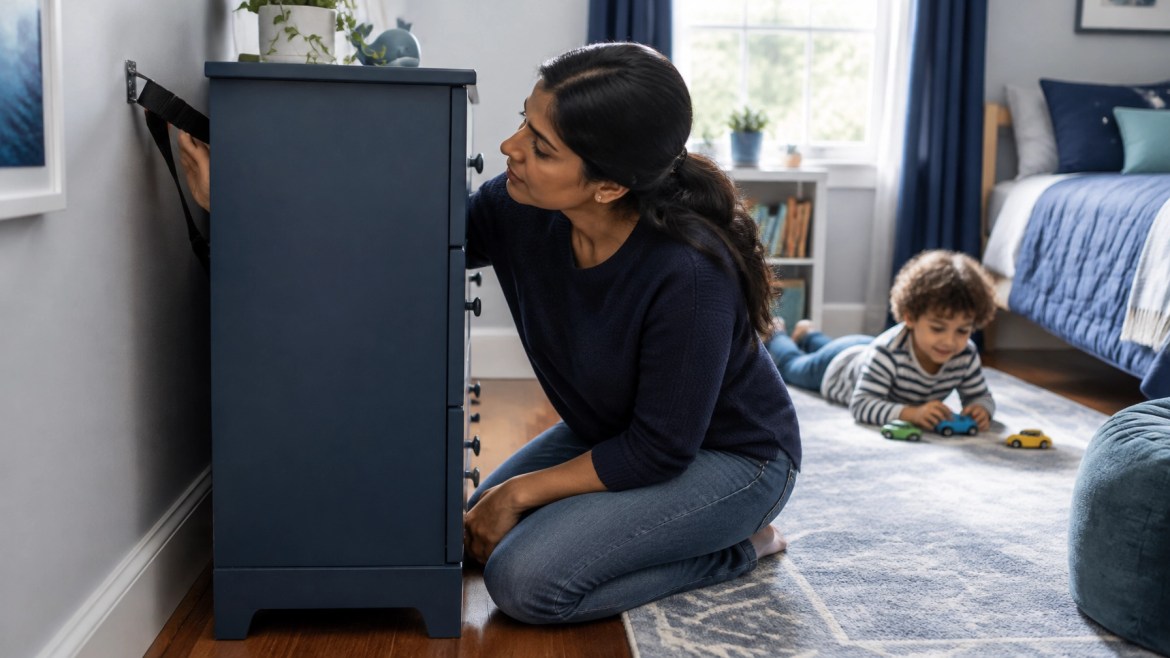
Many dressers include an anti-tip kit. If yours did not, or the kit is missing, purchase one designed for the unit. Follow the kit’s instructions and check that the fasteners are suitable for your wall and furniture.
For a typical installation into a wood stud:
- Use a stud finder to locate the stud and confirm its position.
- Attach one bracket to a solid wood part of the dresser, following the kit instructions.
- Place the wall bracket about 1 to 2 inches below the top of the unit, or as directed by the kit.
- Drill a 1/8-inch pilot hole into the stud if specified, then fasten the wall bracket with an approximately 2-inch wood screw.
- Connect the strap and tighten it until snug. Check that both brackets are firmly secured.
Do not rely on a screw in drywall alone to hold the restraint. If you are unsure about the wall material, furniture construction, or correct hardware, check the kit maker’s instructions or ask a qualified professional.

Make the TV Setup Safer
The deadliest arrangement to avoid is a TV placed on top of a dresser. Move a flat-screen TV to a low, stable stand that is designed to support it, and secure the TV and stand according to their manufacturers’ instructions. If you use a wall mount, ensure it is installed correctly and suitable for the wall and television.
Older tube-style TVs are particularly heavy. Keep them entirely away from children’s spaces rather than placing them on a dresser or another piece of furniture a child could climb. Do not put tempting toys, remotes, or other items on top of furniture where a child may reach for them.
Room-By-Room Tip-Over Checklist
Take a few minutes to walk through the rooms your child uses. Look at furniture from a toddler’s perspective: drawers can become steps, shelves can invite climbing, and a TV remote can be a tempting target.
- Bedroom: Anchor the dresser, wardrobe, and bookcase. Keep the TV off the dresser. Move toys and other appealing items away from high shelves.
- Living Room: Secure the TV and its stand. Anchor media units, bookcases, and cabinets that could be climbed or pulled.
- Play Area: Check storage units and shelving, including furniture that may have been moved or rearranged. Anchor each piece where it currently stands.
- Shared or Guest Spaces: Check rooms your child visits, even if they are not used every day. Ask caregivers to look at the furniture and TV setup, too.

Thousands Of Dressers Were Just Recalled
This check matters right now more than usual. On October 8, 2026, the CPSC announced the recall of about 12,078 Romorgniz six-drawer dressers, sold on Amazon from May 2025 through August 2026 for between $100 and $170. The dressers are unstable unless anchored to a wall and violate the federal stability standard, creating tip-over and entrapment hazards. You can read the full details in the CPSC recall notice.
If you own one, stop using it unless it is securely anchored, keep children away, and get your refund: write RECALLED on the dresser, remove all drawers, email photos of the marked and disassembled unit to Romorgnizrecall@outlook.com, then dispose of it. The manufacturer offers a full refund.
It is not an isolated case. Recent months have brought recalls of WLIVE, AOWOS, YITA, Gunaito, YaFiti, and Bealife dressers for the same reason, and many of them came from the same online marketplaces. If a dresser in your child’s room arrived flat-packed from a big online retailer, treat the anchor check as urgent, not optional.
CPSC estimates a tip-over injury sends someone to the emergency department about every 30 minutes. Know a parent who needs this? Send it to them.
Frequently Asked Questions
Should I Anchor A New Dresser?
Yes. A newer dresser may meet the current stability standard, but anchoring adds an important safeguard. Secure furniture according to the manufacturer’s instructions and use an appropriate anti-tip kit.
Is Anchoring Enough If My Child Knows Not To Climb?
Anchoring is a practical protection that does not depend on a young child remembering a rule every time. Keep teaching safe behavior, but do not rely on supervision or reminders instead of securing furniture.
What If I Rent Or Cannot Find A Stud?
Check with your landlord before installation if needed, and use the furniture or anchor manufacturer’s guidance for your wall type. If you cannot confirm a safe, secure installation, ask a qualified professional for help. Avoid relying on drywall alone.
Strengthen Your Home Safety Routine
A short room-by-room check can help make your home safer without a major project. Explore SCN’s parent resources and resource hub for practical guidance you can use as your family’s needs change.
Join the Secure Children’s Network community for updates and family safety resources.
Have you anchored the dresser and checked the TV setup in every room your child uses? Share what helped you get it done.
If this helped, share it with another parent and follow Secure Children's Network on Facebook, X and LinkedIn for safety alerts.
Discover more from
Subscribe to get the latest posts sent to your email.