Author: Janice Robinson-Celeste
A toddler spots the car key fob you set down for a moment, or reaches for a singing birthday card. These ordinary household moments are why button battery dangers deserve a quick check: if a battery gets stuck in a child’s esophagus, it can cause serious burns in as little as two hours.
Quick Review
- Suspect a child swallowed a button battery? Go to the emergency room immediately. Do not wait for symptoms.
- Do not induce vomiting. For a child at least 12 months old, honey may be given only in specific circumstances while traveling to the hospital. Never delay care to find it.
- Check everyday gadgets such as key fobs, remotes, greeting cards, and light-up toys.
- Secure spare batteries in their original packaging and store them out of children’s reach.
- Check recalls, including the September 2026 recall of Projecting Finger Light Toys.
Button Battery Dangers: Why Speed Matters
Coin-shaped batteries can look like harmless little discs, but swallowing one can trigger a chemical reaction that burns tissue. A child may not show symptoms right away, so a normal appearance does not rule out a battery ingestion. The National Capital Poison Center’s guidance says suspected ingestion needs immediate medical attention and an X-ray to locate the battery.
The scale of the problem is serious. A CPSC statement from Commissioner Richard Trumka noted that more than 70 children had died after swallowing button batteries. Separately, CPSC reported 27 child deaths from 2016 to 2021 and estimated about 54,300 emergency-room-treated injuries related to button cell or coin batteries from 2011 to 2021. Those injury figures cover batteries that were ingested or inserted, not only swallowing incidents.
Recent data also point to a growing burden. A 2026 study in The Laryngoscope identified 24,891 pediatric emergency department visits involving button battery exposures from 2020 through 2024. Its annual estimates rose from 3,785 visits in 2020 to 6,424 in 2024, averaging about 4,978 a year. The researchers described rising visits despite safety efforts; the findings are based on national injury data and do not mean every visit involved a confirmed ingestion. Read the study.
Nearly 6,400 kids hit ERs for button batteries in 2024, up more than two-thirds since 2020.
Know a parent who needs this? Send it to them.
Check These Everyday Battery Hiding Places
You may already keep loose batteries locked away. The harder-to-spot risk is a gadget with a battery compartment that has come loose, was left open, or is easy for a child to access.

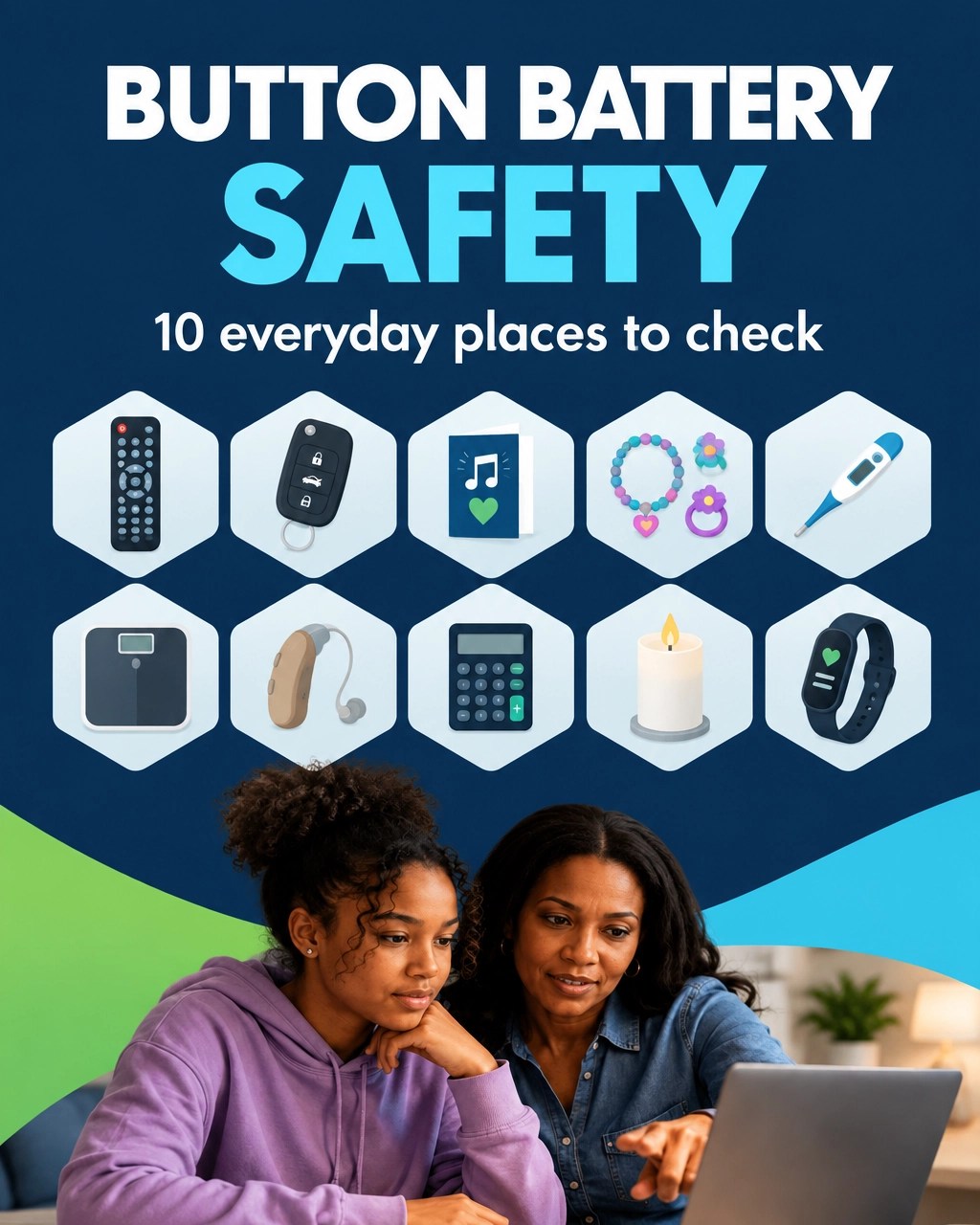
Look around your home for button or coin batteries in:
- Remote controls, mini remotes, and key fobs
- Car keys, calculators, and fitness trackers
- Singing greeting cards and flashing toys
- Light-up shoes, jewelry, and novelty accessories
- Thermometers, bathroom scales, and flameless candles
- Hearing aids and their battery packaging
When checking a device, look for a battery door that is loose, damaged, missing a screw, or not closing securely. Keep used batteries out of reach too. A spent battery can still pose a serious hazard if swallowed.
Check The Recall And Secure Batteries
On September 10, 2026, the CPSC announced a recall of about 179,739 Cade California Electronic Projecting Finger Light Toys sold on Amazon from March 2015 through July 2026. The concern is that children can easily access the button cell batteries. If you have these finger lights, stop using them and follow the CPSC recall instructions. The company is offering a full refund through ccecamazonservice@gmail.com.
The recall is one example among several similar CPSC actions in 2026. The agency has also recalled light-up toys from ZMC Group, toys from ABC Trading, and coin-battery pouches from EEMB USA and LiCB, where the packaging did not meet child-resistant requirements. Bmrwtg LED tutu skirts were also recalled over accessible batteries. Check the recall notices for product details and remedies.

Reese’s Law, signed August 16, 2022, led to federal requirements for covered consumer products containing button or coin batteries. Battery compartments generally must require a tool or two independent, simultaneous hand movements to open, and products must carry warnings. The rule applies to products manufactured or imported on or after October 23, 2023, with enforcement discretion through March 19, 2024, according to the Federal Register rule. Still, a rule is not a substitute for checking products already in your home, especially older items and recalled products.

As a simple household routine, check battery compartments when you bring home a new toy or gadget, and after changing a battery. Keep spare and used batteries in secure storage, and promptly follow local guidance for battery disposal.
What To Do If You Suspect A Child Swallowed One
Go to the emergency room immediately and tell medical staff you suspect a button battery ingestion. Do not wait for symptoms, and do not induce vomiting. The child needs an immediate X-ray to locate the battery so clinicians can determine what care is needed.
The Poison Center says that if the child is 12 months or older, can swallow, and the battery may have been swallowed within the previous 12 hours, give 10 mL of commercial honey every 10 minutes, up to six doses, while traveling to the hospital. Honey is not for children under 12 months and is not a treatment or a reason to wait at home. If it is not immediately available, go without it.
For help while arranging care, call the National Battery Ingestion Hotline at 800-498-8666 or Poison Help at 800-222-1222. Follow the poison center’s instructions, but do not delay emergency evaluation.
Frequently Asked Questions
Can A Child Seem Fine After Swallowing A Battery?
Yes. A child may initially have no obvious symptoms. Treat a suspected ingestion as an emergency and seek immediate care rather than waiting to see how the child feels.
Should I Try To Make My Child Vomit?
No. Do not induce vomiting. Go to the emergency room and contact Poison Help or the National Battery Ingestion Hotline for guidance.
Does The Law Mean Every Older Product Is Safe?
No. Reese’s Law established requirements for covered products manufactured or imported after the rule’s effective date, but products already in homes can still have accessible batteries. Check compartments, packaging, and current CPSC recall notices.
Take One Practical Step Today
Check one room for button batteries and devices that use them, then make sure replacement batteries are secured and any recalled items are set aside. For more family guidance, explore SCN’s parent resources and safety resources.
Join the Secure Children’s Network newsletter for practical safety guidance and updates. Explore SCN’s website to find our latest resources.
Which gadget in your house surprised you when you checked its battery compartment? Share your experience in the comments.
If this helped, share it with another parent and follow Secure Children's Network on Facebook, X and LinkedIn for safety alerts.
Discover more from
Subscribe to get the latest posts sent to your email.